
What Field Experience Brings to Security System Design
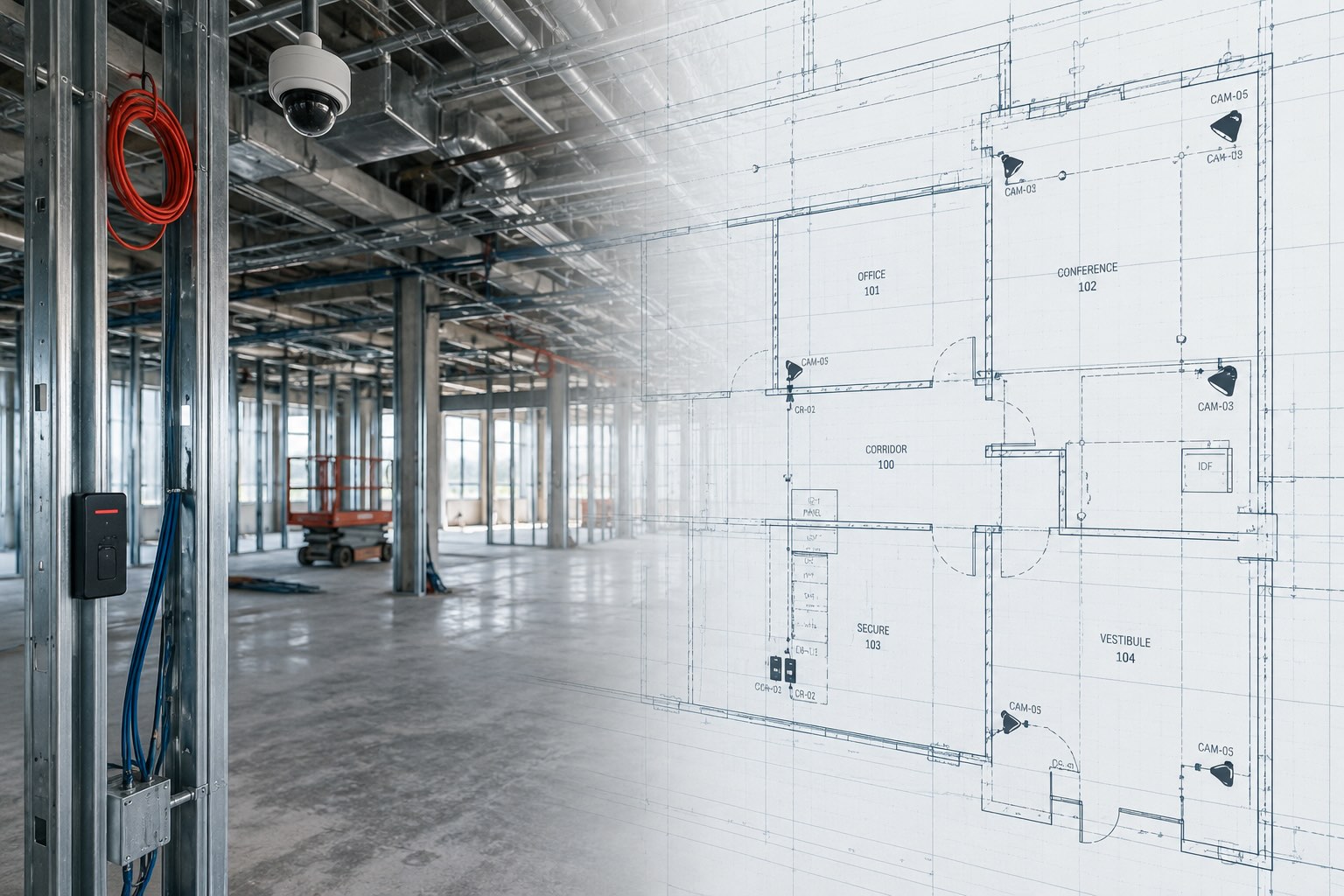
Field experience adds practical insight to security design, helping improve constructability, coordination and maintenance...
Over the past decade, building technology has evolved fast—and so has the way we design it. Most designers have moved from 2D drafting to 3D Building Information Modeling (BIM) tools like Revit, which help visualize how every system comes together.
As a firm focused on technology systems in buildings, we saw early on how BIM could help us coordinate smarter, faster, and with fewer surprises. This area of expertise has resulted in significant savings in both time and budget on some of the most fast-paced and complex projects in our industry today. Over time, our team developed custom tools that make everyday Revit workflows faster and more reliable.
Revit tools are commonplace in design, so what makes TEECOM's custom workflows different? Our team collaborated with our in-house experts in data science, ICT engineering, and BIM to develop these tools. We focused on addressing critical pain points experienced on our large-scale data center projects.
Ideally, technology consultants like TEECOM are brought on early during the design process to coordinate IT spaces and security requirements. However, that is not always the case. Being brought on during later design stages necessitated the need to update large quantities of rack equipment, networking gear, and security door hardware quickly to ensure projects remained on schedule.
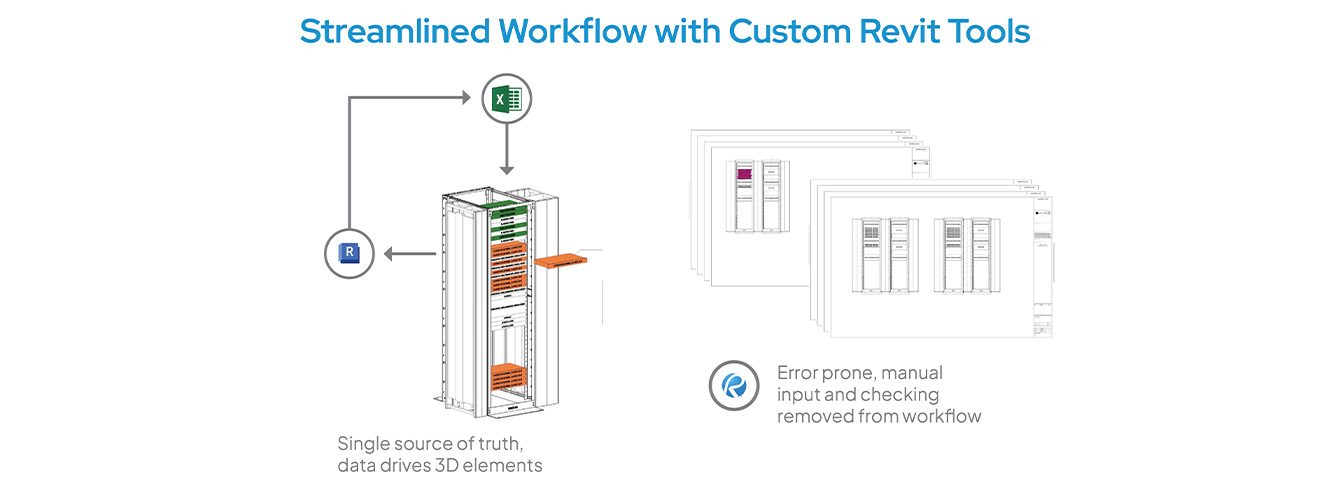
To solve this, we developed automation tools—ACS Arrangements, Rack Builder, and Connectivity Schedules—that drive efficiency, accuracy, and collaboration. These workflows provide the most value during early- to mid- design phases, allowing our team to coordinate with other disciplines quickly during space planning and technical drawing development. Before these tools, updating a rack or door detail could take hours of back-and-forth. Now, it’s just a few clicks—keeping our team focused on high-value design instead of repetitive modeling.
Our team took the initiative on adopting these digital tools and processes to address common issues we encountered on large-scale projects. These challenges often include schedule delays, issues with accuracy and consistency across portfolios, and complex designs that are difficult to scale.
We have found great success in using our ACS Arrangements, Rack Builder, and Connectivity Schedules to overcome each of these challenges.
Our Revit automation tools provide immediate value by reducing manual effort. ACS Arrangements, Rack Builder, and Connectivity Schedules each save up to 70 percent of time on manual entry per project, particularly as project complexity scales. This allows staff to focus on higher-value tasks such as design strategy and client collaboration.
Automated processes uphold client standards, ensuring every door, rack, or connectivity diagram is produced with precision.
Connectivity Schedule ensures that the spreadsheets containing all the data for each data outlet on the project match the reference on the sheet—the two cannot be different, as the data comes directly from the schedule. ACS Arrangements ensure that all doors with specific access control requirements are identical in terms of the devices present, critical mounting height, and other key design criteria. This enables the positioning of devices to accommodate architectural differences while maintaining door functionality.
Rack Builder enables telecom rack elevations to be consistent across multiple sheets. The information is derived from a single source of truth, minimizing the effort required to maintain different sets of information.
All our tools are client agnostic, we can adopt custom symbols, update model geometry and include any shared parameters needed. All the tools can be fully integrated into any asset management process such as COBie, or we can use the high Standard TEECOM library versions.
As projects evolve, our custom BIM workflows handle changes exponentially more efficiently. Whether adding hundreds of new devices or revising specifications mid-project, automation enables rapid and accurate updates that would otherwise overwhelm manual workflows.
The critical benefit here is that the metadata is embedded into the elements. This means the data is still useful—even if the model is viewed in non-native software or if supplementary documents become separated during refurbishment. This process provides organizations with more comprehensive project documentation, which is particularly useful when scaling data center facilities.
One of the major benefits of utilizing our highly skilled BIM designers is their ability to leverage our custom tools to provide detailed drawings that can be easily scaled.
For example, on a recent project for a data center client, our team was able to absorb a client-directed design change—issued only a week before the Technical Design deadline—and still save an estimated 80 hours through our streamlined process. Using traditional 2D modeling tools, this would have been an impossible task to achieve and keep the project on schedule. However, our BIM team adopted the changes quickly because of the tools we had developed in Revit.
While our tools were built for fast-paced data center projects, we’ve found they benefit any large, standardized building program—whether it’s a hospital, university, or corporate campus.
Organizations and their design teams reap the benefits of projects that are delivered consistently to their standards and on schedule due to our highly specialized team of BIM engineers and our custom tools. Engineers will spend less time checking drawings for consistency, and production staff utilizing these tools save countless hours doing manual tasks.
Having these workflows available allow engineers with high level design expertise to make changes to the model and data directly with only basic Revit knowledge necessary. Making the model and data accessible allows our team to focus efforts on more key areas of the design, and ensures the people best qualified to make design changes are able to do so directly.
Utilizing our years of experience and custom tools, our BIM team can significantly reduce manual effort—saving 50–70 percent of production time—while ensuring accuracy, consistency, and regulatory compliance. By linking engineering and production through shared schedules and embedded metadata, our team can efficiently handle design changes, support collaboration across disciplines, and deliver projects on schedule with reduced errors.
Interested in learning about how our BIM team can make your next project more efficient? Send us a message on our contact page to continue the conversation.
Stay ahead of the curve with our latest blog posts on industry trends, thought leadership, employee stories, and expert insights.